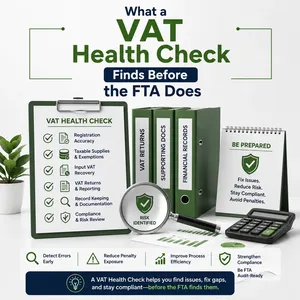
In the earlier years of VAT in the UAE, a business could make errors, and inconsistencies between its various filings could go unnoticed for a long time. That era is ending. The Federal Tax Authority has significantly increased its capability to detect errors, using digital tools that cross-reference a business’s different filings and records against each other. Mismatches that once passed quietly now trigger automatic flags. This changes what VAT consultancy needs to do: it is no longer enough to file returns on time, the numbers across all of a business’s filings have to reconcile, because the FTA is now actively checking that they do. Understanding this shift is essential for staying out of trouble.
A note on this piece: enforcement practices and penalty rules evolve. The general direction described here should be confirmed against the current official FTA position.
How the FTA Cross-References Your Data
The key change is that the FTA no longer looks at each filing in isolation. Reporting indicates it now cross-references data across a business’s VAT returns, corporate tax filings, customs declarations, and bank records, and flags inconsistencies automatically. The implications are significant. If a business reports one revenue figure for corporate tax and a different one implied by its VAT filings, that mismatch can trigger a flag. If its declared activity does not align with its bank records or customs data, that too can draw attention. Errors and inconsistencies that would once have required a manual audit to uncover are now surfaced automatically by cross-referencing, which is exactly why businesses are being caught for things they previously got away with.
Why This Raises the Bar for VAT Compliance
This cross-referencing means VAT compliance can no longer be treated as a standalone exercise of filing returns correctly in isolation. The VAT numbers have to be consistent with everything else the business reports:
- VAT and corporate tax positions need to reconcile, built from the same underlying data with documented reasons for any legitimate differences.
- Declared supplies should align with customs and bank records, so there are no unexplained mismatches to flag.
- Records must be complete and consistent, since gaps and contradictions are exactly what automated checks detect.
- Filings across taxes need to tell one coherent story about the business, rather than being prepared separately without reconciliation.
Self-Correction Is Cheaper Than Being Caught
Alongside better detection, the penalty framework rewards businesses that fix their own errors. Reporting on the current regime indicates that voluntarily disclosing and correcting an error costs far less than having the FTA discover it, where a higher flat penalty applies. Combined with the FTA’s improved detection, this creates a clear logic: with errors more likely to be caught than ever, and self-correction much cheaper than being caught, the sensible course is to find and fix problems proactively. Waiting and hoping inconsistencies go unnoticed is a losing strategy now that the cross-referencing catches them, and an expensive one given the penalty gap between self-correction and discovery.
What Modern VAT Consultancy Now Means
All of this changes what good VAT consultancy provides. It is no longer just about preparing and filing returns; it is about keeping a business’s VAT position accurate, reconciled with its other filings, and defensible under the FTA’s cross-referencing, and about identifying and correcting issues before they are flagged. A capable VAT consultant now helps a business ensure its VAT, corporate tax, and other records tell one consistent story, and advises on voluntary correction where needed. For businesses navigating this more demanding environment, ongoing VAT consultancy has become about staying continuously compliant and consistent, not just meeting filing deadlines, which is a meaningfully different and more valuable service than it used to be.
TRC Pamco provides VAT consultancy in Dubai and Abu Dhabi built for the FTA’s cross-referencing era, keeping your VAT position accurate, reconciled with your other filings, and defensible, and advising on correction before issues are flagged. Explore our VAT consultancy services or get in touch with our team.
Frequently asked questions
How does the FTA detect VAT errors now?
Reporting indicates the FTA now uses digital tools to cross-reference a business’s VAT returns against its corporate tax filings, customs declarations, and bank records, flagging inconsistencies automatically. Mismatches that once required a manual audit to find are now surfaced automatically, so errors that previously went unnoticed are increasingly caught.
What kinds of inconsistencies trigger an FTA flag?
Mismatches between filings, for example a revenue figure reported for corporate tax that differs from what VAT filings imply, or declared activity that does not align with bank or customs records. Automated cross-referencing detects these contradictions, which is why filings now need to reconcile with each other.
Why do my VAT and corporate tax filings need to match?
Because the FTA cross-references them, and unexplained differences can trigger a flag. VAT and corporate tax positions should be built from the same underlying data, with documented reasons for any legitimate differences in timing or recognition, so the filings tell one coherent, defensible story about the business.
Is it better to correct a VAT error myself?
Generally yes. Reporting on the current penalty regime indicates voluntarily disclosing and correcting an error costs far less than having the FTA discover it, which carries a higher penalty. With detection improving, proactively finding and fixing problems is both cheaper and lower-risk than hoping they go unnoticed.
What does VAT consultancy involve beyond filing returns?
Modern VAT consultancy keeps a business’s VAT position accurate, reconciled with its corporate tax and other filings, and defensible under the FTA’s cross-referencing, and identifies and corrects issues before they are flagged. It is about continuous compliance and consistency across filings, not just meeting filing deadlines.